Lesson Plan: Basic Fiber Optics, Introduction and Overview - Online Course With Certificate of Completion Intended For:
Level:
What You Will Learn In This Basic Self-Study Program:
Related Programs
Get your certificate of completion for taking the "Fiber U Basics of Fiber Optics" online self-study program. See below. This Fiber U self-study program is designed to familiarize anyone just starting in fiber optics with the technology and processes involved in fiber optic network design, installation and operation. It can also refresh and improve the knowledge of the individual with some training and/or experience, such as FOA CFOTs. It is strictly focused on the practical aspects of fiber optics, not intended to try to teach the theory, just the things one needs to design, install, test and use fiber optic networks. We also try to explain the variety of the components and technological approaches used and how to choose among them. One of the most important points of this program is to include the latest technology. Too many courses teach obsolete theory and practice, out of obsolete textbooks! FOA updates its self-published books, websites and videos continuously to keep them the most up to date available anywhere. This course is kept up to date and will teach differences between applications (telco/Internet/CATV/LAN, etc.) so the student can intelligently work in today's environment. Many courses are criticized because they are too specific or prejudiced to one application, technology or manufacturer. We will explore the spectrum with you and tell you where to go to find out more. This program has been developed as a cooperative effort of many volunteers from the FOA. If you have comments or suggestions on how to improve it, please contact us at info@foa.org. KSAs - Knowledge, Skills and Abilities The FOA uses KSAs - knowledge, skills and abilities - to set the standards for what a technician needs to know and what skills and abilities they must have to work effectively in fiber optics. Knowledge is acquired from classroom instruction or self-study using available reference materials like textbooks, websites, videos, and online courses like this one. Once you have gained the knowledge you need, how do you gain the skills required? On-the-job-training (OJT) is a common way of learning those skills, as is getting trained in a school with hands-on labs or from manufacturers who tech how their products are to be used. But many ask "Can those skills also be developed by an individual practicing on their own?" Certainly! Many of us in the business learned (and continue to learn) that way. To facilitate learning on your own or with an experienced tutor - often someone you work with - FOA has created the Fiber U Basic Skills Lab that leads you through the steps to learn how to use tools, prepare cables, splice, terminate and test them. You will find links to the Fiber U Basic Skills Lab in the sections of this course on cables, termination and splicing and testing. How This Self-Study Program Works This Fiber U self-study program will divide the basics of fiber optics into ten topics - see the links below. Each topic will have a brief introduction to the subject, telling you what you should learn from that lesson, link you to reference materials in 3 formats: FOA YouTube Videos, pages in the FOA Online Reference Guide to Fiber Optics and a chapter in the FOA Reference Guide to Fiber Optics printed book for you to study. Each lesson will have a quiz for you to test your comprehension. Quizzes can be taken online or you can answer the questions following each chapter in the textbook and a link is provided to the correct answers. When you take the quiz online, it will grade your answers and give you the correct answers along with an explanation. After you check your answers, return to the study materials to find out why you missed any questions. When you finish all lessons, you should be well-versed in the basics of fiber optics and ready for more! The corresponding lessons in the Fiber U Basic Skills Lab which shows you how typical installation processes are done are also linked below.  Get a "Certificate of Completion" When You Complete The Course After you complete the Fiber U Basic Skills Lab Copper Cabling online self-study course, you can now take an online exam and, when you pass the exam, get a "Certificate of Completion" for this course. You should complete all lessons including taking the quiz ("Test Your Comprehension") at the end of every lesson. When you think you are prepared, you can take an online exam for a nominal fee ($20) which will give you a "Certificate of Completion" for this course. Please note: receiving this Fiber U Certificate of Completion does not include FOA certification or membership but it does become documentation of your knowledge of fiber optics and should be part of your portfolio of documented knowledge, other training and work experience that can qualify you to apply for FOA direct CFOT certification through the FOA "Work to Cert" or "OJT-to-Cert" program. For more information on the FOA and its certification programs, go to the FOA page on certification. For information on the FOA "Work to Cert" direct certification program for those with industry experience, go here. More details are on the last lesson. Read more. Learning More and Developing Skills Online courses can help you develop the knowledge of a subject like fiber optics but are not going to provide the hands-on exercises needed to develop the skills used in working with the actual components. If you are just getting started in fiber optics, you should consider attending an FOA-Approved school where you will be trained in hands-on labs to develop the skills needed to be successful in fiber optics. If you already have equipment available, you can also use the Fiber U Basic Skills Lab. Reference Materials You can take this Fiber U Online course using any of these online or printed reference materials. Most lessons include options for all of them, so you can choose the methods you prefer and learn from easiest. However, we recommend you start with the YouTube videos for a quick overview, then read either the online or printed Guide materials. FOA YouTube Videos  All lesson plans include FOA YouTube video lectures on the topic. FOA Online Reference Guide to Fiber Optics 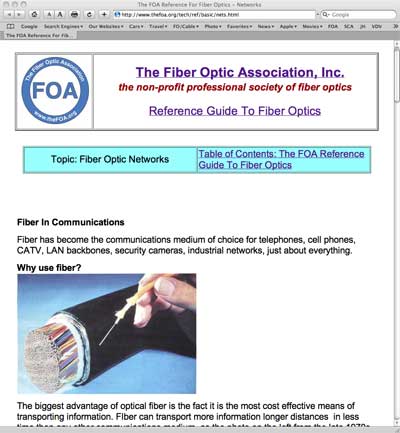
All lesson plans include links to the FOA Guide pages on relevant topics. FOA Reference Guide to Fiber Optics textbook (can be purchased from Amazon.com, Createspace, or in electronic format for the Kindle or iPad) 
All lesson plans include links to the relevant chapters of the FOA Reference Guide To Fiber Optics. Lennie Lightwave's Guide to Fiber Optics  Lennie Lightwave's Guide to Fiber Optics is where many people get started in fiber optics It's a short online or printed Book introduction to fiber optics - a great place to get started. Lennie Lightwave's Guide to Fiber Optics (online) and available printed from Amazon. Ready?  Let's get
started!
Let's get
started!Lesson Plan: Read the materials linked on each lesson plan and take the quiz.
How To Get Your Certificate of Completion For This Course *Available lessons in the Fiber U Basic Skills Lab This information is provided by The Fiber Optic Association, Inc. as a benefit to those interested in teaching, designing, manufacturing, selling, installing or using fiber optic communications systems or networks. It is intended to be used as an overview and/or basic guidelines and in no way should be considered to be complete or comprehensive. These guidelines are strictly the opinion of the FOA and the reader is expected to use them as a basis for learning, as a reference and for creating their own documentation, project specifications, etc. Those working with fiber optics in the classroom, laboratory or field should follow all safety rules carefully. The FOA assumes no liability for the use of any of this material. |
| Table of Contents: The FOA Reference Guide To Fiber Optics (C)2012-20, The Fiber Optic Association, Inc. |